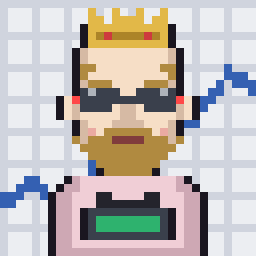
9,999 brokers working the trading floor. Every trait is placed by hand on a 32x32 grid and mirrored down the centre, so the whole collection carries zero asymmetric pixels. Your token is your license.
Most collections roll dice and hope. Here every count is fixed before generation. If a trait reads 0.5%, exactly 50 brokers carry it. Fifteen categories, 130 hand-drawn options, apportioned with largest-remainder maths.
Asymmetric pixels across all 9,999. Sprites are written as 16-pixel half-rows and mirrored, so symmetry holds by construction.
Distinct pixel hashes. No two brokers render the same image. Verified, not assumed.
The collection is deterministic. Seed 1337 reproduces all 9,999 brokers byte for byte, and the combined SHA-256 is published below before minting opens. Nobody can quietly reshuffle the rares.
Suits, pinstripes, shades, crowns, bull horns, cigars, laser eyes. Every piece drawn pixel by pixel, never upscaled or diffused.
The rarest licenses in the collection, ranked by combined trait scarcity. Crowns, bull horns and gold chains are capped in the low dozens.
All 9,999 licenses, filterable by every trait. These are the exact counts that ship in the on-chain metadata.
Minting runs on our own contract, deployed natively on Robinhood Chain, the Ethereum L2 where tokenized stocks actually trade.
Add chain ID 4663 to any EVM wallet. Bridge a little ETH for gas. L2 fees are cents.
Mint straight from this page. Every license is sealed beforehand, so nobody can cherry-pick rares mid-drop.
When the drop closes the base URI flips once and all 9,999 brokers reveal together.
Secondary lives on OpenSea from day one. Floor, rarity and offers all native to the chain.
Minting calls our own contract directly from this page, so the full payment reaches the treasury with nothing skimmed in between. Price and limits are read from the contract, not from this page.
Trading revenue lands in the engine, gets filed into a round, and is split evenly across every active license. Same share for every seat, so nobody can hand themselves a bigger cut. Each holder then chooses how their share is paid: keep it in ETH, or point up to three tokenized stocks at it and the engine buys them on delivery.
| License | Claimable ETH | State | Collects | |
|---|---|---|---|---|
| Connect a wallet to see your licenses. | ||||
Pick up to three assets. Your equal share of every round is spent on them at the split you set. Leave it on ETH to be paid in ether.
Royalties and floor revenue are sent to the engine. The balance sits in an unsealed pot, visible above, until it is filed.
A keeper seals the pot into a numbered round together with how many licenses were active. Sealed rounds are immutable, so a late arrival cannot dilute a past payout.
Each active license draws the pot divided by the number of active licenses. Every seat earns the same, so there is no weight to set and nothing to prove.
On delivery your share is spent the way you set it. Each chosen stock is bought on Uniswap at a price floored by the pool's own time-weighted average, so a thin moment cannot short you; a leg that cannot fill rolls to the next round and is never lost. Anything left on ETH is delivered as ETH. It all lands in your token vault, which follows the NFT if you sell, and a claim always pays the current owner.
Content-addressed storage means the CID is the hash of the art itself. Change one pixel and the address changes. Check it yourself.
An ERC-721 token on Robinhood Chain pointing at a 1024x1024 pixel broker stored on IPFS. Nothing else is promised. No yield, no revenue share, no obligations. If anyone tells you an NFT guarantees returns, walk away.
It is an Ethereum L2 built on Arbitrum, and it is where tokenized stocks like NVDA, AAPL and GOOGL actually trade. A collection of brokers belongs on the chain where the stocks live. OpenSea supports it natively, so listings, floor price, rarity and offers all work from day one.
The collection is deterministic. Seed 1337 reproduces all 9,999 brokers byte for byte, and the combined SHA-256 of every image is published above before minting opens. Anyone can regenerate, re-hash and compare.
Every sprite is written by hand as a 16-character half-row and mirrored across the centre axis, so bilateral symmetry is guaranteed by construction. Verified at zero asymmetric pixels across all 9,999. Rarity counts are exact rather than random.
Images and metadata are pinned to IPFS as content-addressed directories. The only mutable step is the reveal, when the base URI flips once from placeholder to the final metadata CID listed above.
Date and price get announced before the drop. The contract is our own ERC721 with max supply 9,999 and a per-wallet cap to keep bots honest, so the full mint price goes to the project rather than a third-party fee.